
Where Are You, Hashem?
an adult version. Part 1/2


This is an important topic, and I was lucky to discuss it with a particularly thoughtful and articulate young woman via email. I think our conversation explains it better than any standalone post, mostly due to her excellent articulation and way of bringing out the points without any of the fluff (I can’t say I was able to respond in kind). So I’m sharing the exchange here for others to read. Especially since I’ve gotten quite a few emails since, touching on these ideas, showing there is a need for this discussion.
Also, final point, this touches on a lot of what atheists are troubled by - for example, a Christian’s experience of spirituality - “meeting Christ,” we deny, yet our experiences we hold sacred. What gives? The next part, as the reader will see, gets into what exactly the religious experience is, and what claims we can make about it - and most importantly what we can’t make about it.
Here’s a message I received in DM’s a couple of months back:1
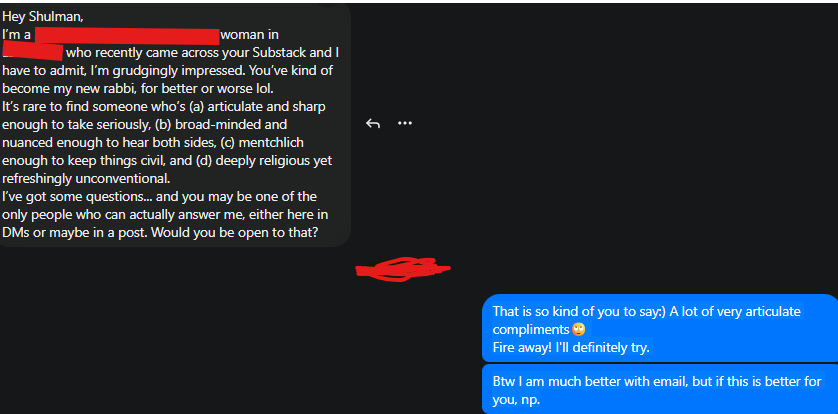
So, we continued via email:
Subject: Questions, Questions

Hey, it’s Leah [name changed] from Substack,
The following is an age-old conundrum of mine... it’s definitely morphed over time but the core issue is the same.
In a sentence, my question is this:
How are we meant to build a personal relationship with a Being we cannot comprehend, imagine accurately, or even recognize in our own experiences?
A couple of concepts that led to this question:
1. There is no greater projection screen than the heavens. Every person will experience G-d differently, depending on their attachment style, subconscious beliefs, self-image, and personal history. It’s pretty obvious that not everything we feel Hashem feels toward us is objectively true.
2. As a teen, in my search for a G-d I could have a personal relationship with, I became a kind of “divine ventriloquist,” writing letters from Hashem to myself, expressing what I believed He might say to me. In essence, it was nothing more than my own imagination. Looking back, I realize I often had Him reinforce unhealthy beliefs and choices.
3. Hormones. Back in the day, I would have moments of intense “divine closeness” that I look back at now and directly connect to wacky teenage hormones and my monthly cycle. Afraid such intensity is not very divine in nature.
4. G-d doesn’t have any emotions. Period. Whenever we assign feelings to Him, it’s describing His behavior, not internal experiences. Whatever “love,” “care,” or “anger” we experience is a projection of our imagination. Yes, they’re the only language we have, but still, calling that “relationship” seems intellectually dishonest to me. Any image, emotion, or concept we attach to Hashem is ultimately inaccurate and limiting, because He is beyond all form and beyond knowing.
When people get all “Hashem-y”, I almost feel like it’s just semantics – it’s just the framework and language and processing style they apply to their external or internal experiences. Not because they actually are encountering or engaging with the Divine.
So again, how to relationship?
What to do when I feel my words are echoing into a void and bouncing back, because there is no way for me to have any understanding of the One with whom I am speaking?
If I can’t trust my own experiences as genuine contact with Him, then what is this “relationship” really? Is it anything more than my longings, hopes, and beliefs reflected back at me? When I feel love, acceptance, or pride from Hashem, is that truly from Him, or just my own psyche speaking in divine tones?
Is the entire idea of a “personal relationship with G-d” simply a human construct that helps people feel spiritually connected, but isn’t actually real? And if G-d is ultimately unknowable, how can He ever truly be found?
If you reached the bottom of this email, I kindly thank you for bearing with me. All and any thoughts, intelligent, intelligible, or otherwise, are most definitely welcome. Looking forward to hearing from you!
Thanks,
Leah
Y’know when you take a kid to the doctor to check something out - like they’re unusually tired - and the doctor doesn’t jump to the scary stuff right away? They’ll first suggest more sleep etc., and only assume anemia or thyroid issues much later. Anyways...
(Also, a lot of times the first response is also figuring out where the questioner is coming from besides the response itself, testing the waters, listening to cues.)
So here is my first attempt, a simpler, but very foundational response:
Leah,
First of all, I love your writing style and parlance.
Second, I don’t know if this is intended, but you are quite the philosopher! And I don’t mean that in a cute way- I mean that this is literally touching on the philosophical sort of conundrum those like Aristotle, the Kuzari and the Rambam were busy with (this is primarily why Aristotle denied creation and what the mekubalim’s sefiros are predicated upon). If there are people who don’t even seem to hear the question, they are not at all philosophically inclined (perhaps for the better?).
I mention this mainly to highlight that this question can be explored on many levels if necessary. But for now, though, we can start ‘simple.’ The truth is that all the complexities and layers are just further clarifications and expansions of this core idea anyways.
Of course I’m just sharing my perspective; you’ll let me know what you think and what resonates - I hope this will give you what to think about, and it will address most of your questions. Moving forward, we can always unpack this more after you digest and let your brain sort out if and what still seems unresolved.
It’s true that Hashem has no דמות, גוף, דמיון, צורה etc. - no body or corporeality - but He did create this world with specific middos (lit. measurements) and and gevulim, with a tzurah, with “gufnius.” And he did so in order to “reveal” Himself, specifically to have a connection with His creations. I won’t get into this too much (unless you want), but let me try to give a mashal that I think helps explain and provides an easier way to think about this.
When two people become friends and go through the process of getting to know each other, or even the very idea of friendship in general - continually knowing and connecting with someone - it seems quite impossible if you think about it. What exactly are you connecting to? To their nose? Their ears? Even their personality - their middos and kochos that make them them - that’s not either the actual person. The actual person is lurking behind it all, peering out from a place where they can’t be seen (often hidden even from our very own selves). Because the actual person is unseeable; the neshama/mind is incorporeal. And that inner “me” is entirely unknowable, locked away from the rest of humanity in a tower (and to know this essence is to be this essence, but I am me and you are you). So to loosely paraphrase: “Questions, Questions, - How are we meant to build a personal relationship with another human being we cannot comprehend or imagine accurately?“ - if you get my gist. Although you can probably begin to recognize the direction I am going, I still want the honors of speaking it out fully and articulately, and thus I continue:
So we have this unknowable part of us which no one else can see or connect with. However, that unknowable “me” has expressions: the inner person is manifested through their personality, through their actions, (and yes, even through the shapes of their nose and ears - not for now...) and we connect with the person through those outward expressions. But to be very clear, though this is probably clear to you naturally, we are not connecting with the external manifestations, we are not connecting to their nose or even to their passions; we are connecting to them via their passions. We are connecting with the inner person through the manifestations, the manifestations merely a handle to grab ahold of our friend.
(This can be an entire discussion on its own, but the truth is that we connect to others because we have some intimate awareness - however rationally limited - of our own inner “me.” We experience the “I” behind all our feelings. When we encounter another person, we recognize the reflections of that same inner “I” within them. Our empathy and connection come from projecting our own sense of self onto theirs, and we intuitively grasp the emotional signals that reach outward from their inner world to ours. Incidentally, this is why we find people today who are confused about their connection with AI models (Hashem yerachem), because they mistake the mimicked externals as if it comes from an inner self which doesn’t exist. But I digress.)
I think this is a very good way to think about our connection with Hashem as well. That even though His essence is completely unknowable and there is no way to understand/connect/even discuss His actual essence which is perpetually and definitionally hidden (to know the Infinite is to be the Infinite), He nevertheless created a world to manifest Himself to us. Through His “ways” and His majesty, His genius and His love (as expressed in the Torah, in the wonders is science, in our daily lives), we can forge a connection with Him, with the Being behind it all, the “You,” the “Attah,” as elusive as that actual Being may be- through the externals which we do experience.
If you followed me until here, we’re doing great. If not, let me know if I can be more clear.
I’ll add one more point that follows from all of this: we connect with others at our “point of connection.” A silly example, two guys bond over their mutual love of the Mets. A Mets fan passes someone on the street wearing a Mets cap, and instantly there’s that unspoken connection (one I don’t fully understand), expressed through a wink, a head nod, a grin that they share. A more girly example, two girls connect over having the same handbag or Taylor Swift adoration and there’s a “you too!” or “you get it!” moment- a bridge which lets them connect.

Of course there are deeper and more meaningful examples, such as sharing the very essence of life and the importance of building a family with a spouse; sharing a lifetime of silly and important memories with siblings; sharing the importance of your very own happiness and success with your parents, etc.. In all these, the “point of connection” is the tool, the handle, to grasp and capture the inner person behind the surface. (Although tbh by guys, they think it truly stops at “Mets” without realizing the depths ;)
And this is why the stronger the point of connection, the stronger the relationship feels - why siblings can be closer than the Mets fans and handbag friends; why friends are constantly finding new excuses to connect. Teenagers, for example, will just ‘hang out’ and find random things to do together, but really, at the core, they’re just trying to feel the connection with the people who get them (their real “point of connection”), using whatever (more immediate) handles they can find. (There’s a ton of relationship advice in these paragraphs lol.)
If you think about it, our connection to Hashem is really no different- He is a Being like us (in a way), and that Inner Being is hidden, but we connect at the “point of connection.” But what exactly is that point with Him? With people, they are embodied and have external personalities, so we have easy ways to connect. But with Him, we are physical and finite beings while He is limitless and infinite. So where is our point of connection? What handles can we grab onto?
The answer to this is exactly our purpose in this world: the more we rise above our limitations, our “אנוכיות” (lit. selfishness, but the English version speaks to me less for some reason) - the more we make our lives about others, about the vitality of the neshama - the more points of connection we create with Him. Conversely, the more we feed our אנוכיות, the more cake we enjoy, the more movies we watch, the more TikToks we scroll, the smaller our point of connection shrinks.
I’ll leave this as food for thought.
Hope things were at least somewhat clear and that I didn’t dump too much at once :)
Please let me know what resonates and I’m looking forward to hearing back.
Best and a good shabbos,
shulman
To be continued…
In case you can’t read that, here is the message I received:
Hey Shulman,
I’m a woman in ____ who recently came across your Substack and I have to admit, I’m grudgingly impressed. You’ve kind of become my new rabbi, for better or worse lol.
It’s rare to find someone who’s (a) articulate and sharp enough to take seriously, (b) broad-minded and nuanced enough to hear both sides, (c) mentchlich enough to keep things civil, and (d) deeply religious yet refreshingly unconventional.
I’ve got some questions… and you may be one of the only people who can actually answer me, either here in DMs or maybe in a post. Would you be open to that?
I responded:
That is so kind of you to say :) A lot of very articulate compliments 🙄
Fire away! I’ll definitely try.
Btw I am much better with email, but if this is better for you, np.
I enjoyed this post and am eagerly awaiting the next installement!
In my opinion the question was less “How do I build a relationship with Hashem” and more “Is there a version of a relationship with God that isn’t just projecting your own beliefs, thoughts and feelings onto a Being who doesn’t have feelings and presumably can’t participate in what we would traditionally call a relationship?”
When you explain that the points of a connection between Hashem and a human are through mitzvot, I am left unsatisfied. We say that the mitzvot are some sort of mystical bridge between the limited and limitless. But how does that bridge work?
When my friend and I go through something which strengthens our bond of friendship, there is a tangible feeling that both of us experience. But in regards to having a relationship with Hashem, are those feelings not just masterful creations of an imaginative mind?
Classically, we cannot "give" anything to God, because His perfection is independent of anything/ anyone. and if He cannot feel, then He cannot love.
but what is a relationship between two parties, when one cannot give and the other cannot love?
Isn't the whole gist of a relationship about giving and receiving, about loving and being loved?
unless we say that love isn't an emotion. but maybe that's just shifting goalposts anyway.